How to talk to your partner about gambling: 7 steps that open the conversation
 Save
Talking to your partner about gambling feels harder than almost any other conversation in a relationship. The first two sentences set the tone for everything that follows, and choosing the right moment matters as much as the words themselves. This guide walks you through preparing for the conversation, what to say when you sit down together and how to respond to the replies you might hear. Visit I Need Help for more support on difficult conversations and where to turn when someone close to you is struggling.
Choose a time when neither of you is rushed
The conversation needs space. A morning before work or an evening when one of you has plans in an hour will not give either of you the time to speak properly or hear what the other is saying.
Pick a day when you both have nowhere else to be for at least two hours. Weekend afternoons work well, or an evening when you can turn off phones and sit without interruption. Avoid moments immediately after a row or when either of you is tired or upset about something else.
The setting matters too. Somewhere private and comfortable where you will not be overheard — your living room, a quiet corner of your home — removes the worry of others listening in and lets the conversation unfold without self-consciousness.
Decide what you want to say before you start
Writing down the three or four points you need to cover keeps the conversation from wandering into accusations or side issues. You are not scripting the whole exchange, but knowing your opening sentence and the main concerns you want to raise stops you from forgetting what matters most once the conversation begins.
Focus on what you have noticed rather than what you assume. "I've seen you checking your phone a lot in the evenings" is easier to hear than "You're obsessed with gambling." One describes behaviour; the other makes a judgement.
Think about what you want from the conversation. Is it an acknowledgement that there is a problem? A commitment to seek help? Simply to let your partner know you are worried? Knowing your own goal helps you steer the conversation without pushing too hard.
Open with what you have observed
The first sentence sets the tone for the rest. Start with a statement of what you have noticed, without blame or exaggeration. "I've noticed you seem anxious lately, and I wanted to check in" or "I saw some notifications on your phone and I'm worried" opens the door without cornering your partner.
Avoid opening with a question that backs them into a corner. "Have you been gambling again?" forces a yes-or-no answer and often leads to defensiveness. A statement of your own concern gives your partner room to respond without feeling attacked.
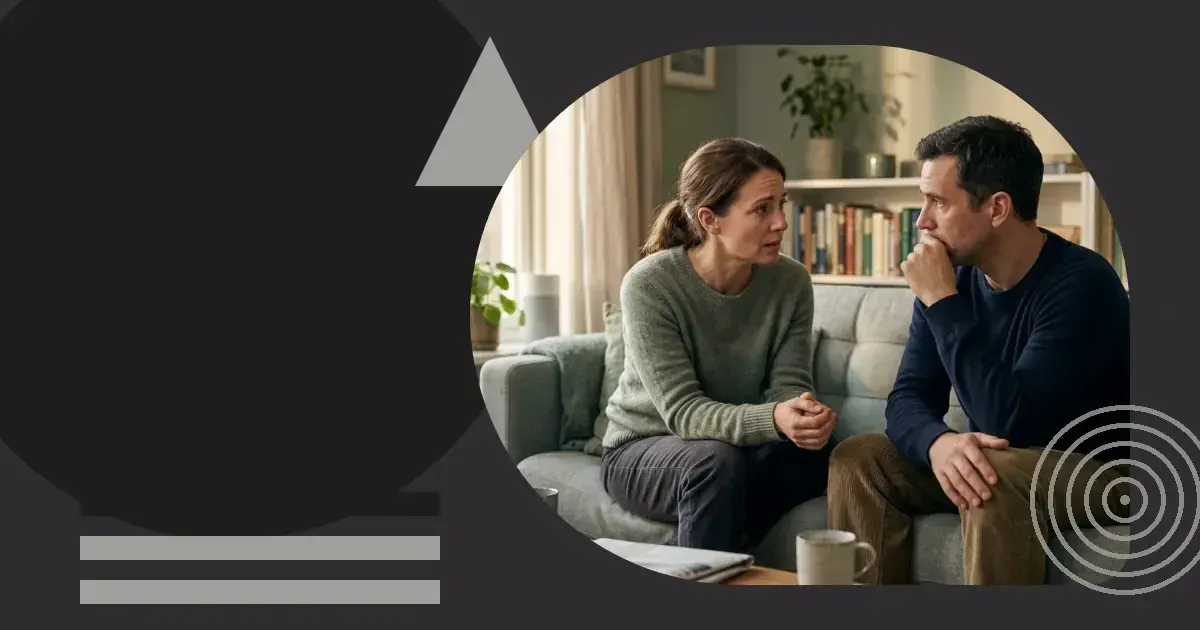
Keep your voice calm and your body language open. Sit next to your partner rather than opposite them, which can feel confrontational. Make eye contact but do not stare. The physical setup of the conversation affects how safe your partner feels to open up.
Listen to the reply without interrupting
Once you have spoken, stop and let your partner respond. This is harder than it sounds, especially if the reply is a denial or an explanation that does not match what you know to be true.
Resist the urge to correct or argue immediately. Let them finish. Interrupting signals that you are not really listening, and the conversation will close down before it has begun.
Pay attention to what is not being said as well as what is. Defensiveness, changing the subject or minimising the problem are all signs that your partner is not ready to acknowledge the full picture yet. That does not mean the conversation has failed; it means you may need to return to it again later.
Name the impact on you and your relationship
Gambling affects more than the person placing the bets. It changes trust, finances, time together and the emotional atmosphere of a home. Naming those effects without dramatising them helps your partner see the consequences beyond their own experience.
"I feel anxious about money now" or "I miss spending time with you in the evenings" are specific and personal. They describe your experience rather than attacking your partner's character.
Avoid statements that predict disaster or make sweeping claims. "You're going to ruin us" or "You never think about anyone but yourself" shut the conversation down. Stick to what has already happened and how it has made you feel.
Suggest a next step together
The conversation should not end with the problem simply stated. Offering a concrete next step — even a small one — gives both of you a sense of direction and shows your partner they are not facing this alone.
Here are practical steps you can suggest:
- Look together at a support organisation such as GamCare and read through what help is available.
- Agree to talk again in a few days, giving your partner time to think about what you have said.
- Set up a joint account for household bills so that essential spending is protected.
- Suggest your partner calls the National Gambling Helpline to speak to someone confidential and non-judgemental.
- Offer to go with them to a support group or counselling session if they want company.
Frame the step as something you do together rather than something your partner must do alone. "Let's look at this together" feels less isolating than "You need to sort this out."
Prepare for the conversation to take more than one attempt
Your partner may not be ready to acknowledge the problem in the first conversation. Denial is common, and shame makes honesty difficult. That does not mean the conversation was wasted.
Give it time. Sometimes a person needs to hear the concern out loud before they can admit it to themselves. Return to the subject a few days later if the first attempt does not lead anywhere.
Keep the tone consistent. If the first conversation was calm and concerned, keep that approach in the second. Escalating to anger or ultimatums too quickly can push your partner further away. If you are finding it difficult to have this conversation on your own, read what to say when someone tells you they have a gambling problem for guidance on responding to the replies you might hear.
Know what to do if your partner becomes defensive
Defensiveness is a reflex when someone feels exposed. Your partner may insist there is no problem, turn the conversation back on you or leave the room. These reactions are frustrating, but they are also signs that the subject matters and that shame is at work.
Do not chase them if they walk away. Let them cool down and return to the conversation later. Pushing harder in the moment rarely helps.
Avoid matching their defensiveness with your own anger. Staying calm does not mean accepting their denial, but it does mean keeping the door open for future conversations.
If your partner's gambling is affecting household finances or putting your family at risk, you may need to take steps to protect yourself even if they are not ready to seek help yet. Setting up separate accounts for essential bills or speaking to a debt adviser can give you some control while your partner decides what to do next. For more on recognising the signs that gambling has become a problem, see how to tell if someone has a gambling problem.
Look after yourself during this time
Supporting a partner with a gambling problem takes emotional energy. You may feel responsible for fixing the situation, or guilty for not noticing sooner, or angry that you are in this position at all.
Those feelings are normal. Looking after yourself is not selfish; it is necessary if you are going to be able to support your partner without burning out.
Talk to someone outside the relationship about what you are going through. A friend, a counsellor or a support group for families affected by gambling can give you the space to process your own feelings without burdening your partner.
| Approach | What it does | When it works best |
|---|---|---|
| Observation-based opening | Describes what you have noticed without accusation | First conversation, when you are unsure how your partner will respond |
| Impact-based opening | Names how gambling has affected you or the relationship | When denial is strong and your partner needs to hear the wider consequences |
| Solution-based opening | Suggests a next step together before discussing the problem in detail | When your partner has already acknowledged the problem but does not know what to do |
Where to turn for help and advice
If your partner is ready to seek help, or if you need support for yourself, several organisations in the UK offer confidential advice and treatment.
GamCare provides support for people affected by gambling, including partners and families. You can reach them at gamcare.org.uk or call the National Gambling Helpline on 0808 8020 133, which is free and available round the clock.
BeGambleAware offers information and signposting to treatment services at begambleaware.org.
GamStop is a free national self-exclusion scheme that blocks access to licensed gambling sites in Great Britain. Your partner can sign up at gamstop.co.uk.
Blocking software such as Gamban (gamban.com, paid subscription) and BetBlocker (betblocker.org, free, multi-platform) can prevent access to gambling sites on all devices in the home. Learn more about blocking options in how to block gambling sites on your devices.
Gambling is for people aged 18 and over. If you share devices with children, parental-control software such as Net Nanny or Qustodio can prevent them from seeing gambling content.
This is an information site. We do not offer personal counselling, legal advice or treatment services. If you or someone you know is struggling with gambling, contact GamCare at gamcare.org.uk or call the National Gambling Helpline on 0808 8020 133 for free, confidential support. Gambling is restricted to those aged 18 and over.
#Partners #Conversations #Denial #Boundaries
Download PDF: Checklist for talking to your partner about gambling PDF, 28 KB
Further reading
Frequently asked questions
What is self-exclusion?
Self-exclusion blocks your access to gambling sites for a period you choose, typically between six months and five years. During that time you cannot open accounts or place bets on any site covered by the scheme.
How do I approach my husband about his gambling habit?
Choose a calm moment when neither of you is rushed, and open with what you have noticed rather than an accusation. Use specific observations and describe how the gambling has affected you and your relationship.
What should I do if my wife denies she has a gambling problem?
Give her time to think about what you have said, and return to the conversation a few days later. Denial is common and shame makes honesty difficult, so the first conversation may not lead to an immediate acknowledgement.